
Locks and keys protect your doors. Contingency plans prepare your team for emergencies. Employee training builds awareness across your organization. But when someone attempts to breach your facility — whether during business hours or in the middle of the night — it is your intrusion detection and monitoring systems that stand between a close call and a costly loss.
Choosing the right combination of security technology is not a one-size-fits-all decision. The level of protection your business needs depends on the nature of your operation, the value of your assets, your hours of operation, and the specific risks your location presents. The goal is to build a layered system where each component reinforces the others, creating a security posture that deters, detects, and enables a rapid response.
Assessing Your Security Needs
Before investing in any system, start with an honest assessment of your vulnerabilities. Walk through your facility and ask some basic questions. How many entry points does your building have? Which areas contain your most valuable assets or sensitive information? Are there times of day when the building is completely unoccupied? Do you share space with other tenants who have independent access? Are there blind spots in your current line of sight — hallways, storage areas, loading docks, or parking lots that are not easily observed?
The answers will tell you where your gaps are and help you prioritize your investment. A retail storefront with high foot traffic during the day and no occupancy at night has different requirements than a warehouse that operates around the clock. A professional office with sensitive client data faces different threats than a construction company with an equipment yard.
Understanding your specific risk profile is the first step toward building a system that actually addresses it.
The Core Components
Most commercial security systems are built from a combination of five core technologies. Each serves a distinct function, and the most effective security plans use several of them together.
Alarm systems. A monitored alarm system is the backbone of after-hours intrusion detection. Door and window contacts, glass-break sensors, and motion detectors work together to identify unauthorized entry and trigger a response. The key word is “monitored.” An alarm that simply sounds a siren is easy to ignore. A system monitored by a central station or a security provider ensures that the alert reaches someone who can dispatch law enforcement or a patrol officer, even if no one from your business is available to respond.
Access control systems. Traditional locks give you a binary choice: the door is locked or it is not. Electronic access control provides far more granularity. Key card, fob, or PIN-based systems allow you to control who can enter which areas, during which hours, and to log every entry for audit purposes. When an employee leaves the company, their access can be revoked instantly without rekeying a single lock. Access control is particularly valuable for businesses with multiple zones of sensitivity — a general office area that all employees can access, a server room restricted to IT staff, and a storage area limited to management, for example.
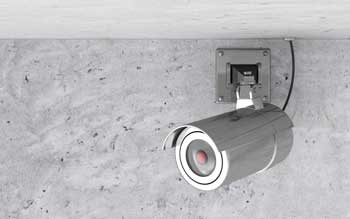
CCTV and camera systems. Video surveillance serves three functions: deterrence, real-time monitoring, and evidentiary documentation. Visible cameras discourage criminal activity before it starts. Live monitoring allows security personnel to observe activity as it happens and respond accordingly. Recorded footage provides critical evidence for law enforcement investigations and insurance claims after an incident.
Modern camera systems have moved well beyond the grainy, fixed-position units of the past. High-definition cameras, night vision, wide-angle lenses, and cellular-connected units that push real-time photo and video alerts to mobile devices have transformed what is possible. The right camera placement — covering entry points, parking areas, high-value zones, and blind spots — multiplies the effectiveness of every other system you have in place.
Fire detection and suppression systems. Fire protection is both a life safety requirement and a business continuity measure. Smoke detectors, heat sensors, and sprinkler systems are the minimum. Monitored fire alarm systems that automatically notify the fire department provide faster response times, especially after hours when no one is on-site to call 911. For businesses with server rooms, document archives, or other areas where water damage from sprinklers would be catastrophic, specialized suppression systems using clean agents offer an alternative worth considering.
Private security officers. Technology detects and records. A trained security officer detects, assesses, and responds in real time. For businesses with higher security requirements — large commercial properties, facilities with significant asset concentrations, or locations with known risk factors — a private security presence provides a level of protection that technology alone cannot match. Mobile patrol officers cover multiple properties on a scheduled or randomized basis, while dedicated on-site officers provide continuous coverage for facilities that warrant it.
Building a Layered System
No single component provides complete protection on its own. An alarm system detects a breach but does not identify the intruder. A camera system records the event but does not physically prevent it. Access control limits entry but does not monitor what happens once someone is inside.
The most effective approach layers these systems so that each one compensates for the limitations of the others. Access control restricts entry. Cameras monitor activity in real time and record it for review. Alarm sensors detect unauthorized access and trigger an immediate response. A security officer provides human judgment and physical presence that no sensor or camera can replicate.
When these layers work together, the result is a security posture that is significantly harder to defeat than any single system operating in isolation.
Training Makes the System Work
Even the best technology fails if the people using it do not understand how it operates. Every security system you install should be accompanied by thorough employee training. Your team needs to know how to arm and disarm the alarm. They need to understand the access control policies and why tailgating — allowing someone to follow them through a secured door — undermines the entire system. They need to know what the cameras cover and what they do not, so they are not relying on surveillance in areas that have no coverage.
Establish clear procedures for common scenarios. What does an employee do if the alarm triggers accidentally? Who do they contact if they notice a camera is not functioning? What is the protocol if an access card is lost? These operational details are what separate a security system from a security plan.
Start With an Assessment
If you are unsure where your business stands or what level of protection makes sense for your operation, start with a professional security assessment. A thorough evaluation of your facility, your operations, and your existing measures will identify your vulnerabilities and help you prioritize investments that deliver the most protection for your budget.
The goal is not to build a fortress. The goal is to build a system that matches your risk, fits your operation, and gives you confidence that your business is protected during every hour of the day.
Security Pros has designed and implemented commercial security systems across Central Oregon for over 32 years. Contact us for a security assessment tailored to your business.
